
We’re pleased to announce the immediate availability of another big free update for Dorico Pro 6, Dorico Elements 6, Dorico SE 6, and (very soon) for Dorico for iPad users. Dorico 6.2 brings significant notation improvements in areas including repeats, guitar tablature and techniques, harmonics, beaming, and more. You can download Dorico 6.2 right now via Steinberg Download Assistant, but as usual we recommend you read on to find out more about all the changes in this update.
As ever, my honey-voiced colleague Anthony has prepared an overview of the changes in this release on our YouTube channel.
For full details of all the changes and improvements, download the complete Dorico 6.2 Version History PDF. Read on to dig into a couple of the highlights in this release.
Repeats
Dorico 6.2 introduces a new Repeats page in Layout Options, in which you will find new options for the display of cautionary clefs, key signatures, and time signatures at repeat barlines and repeat jumps:
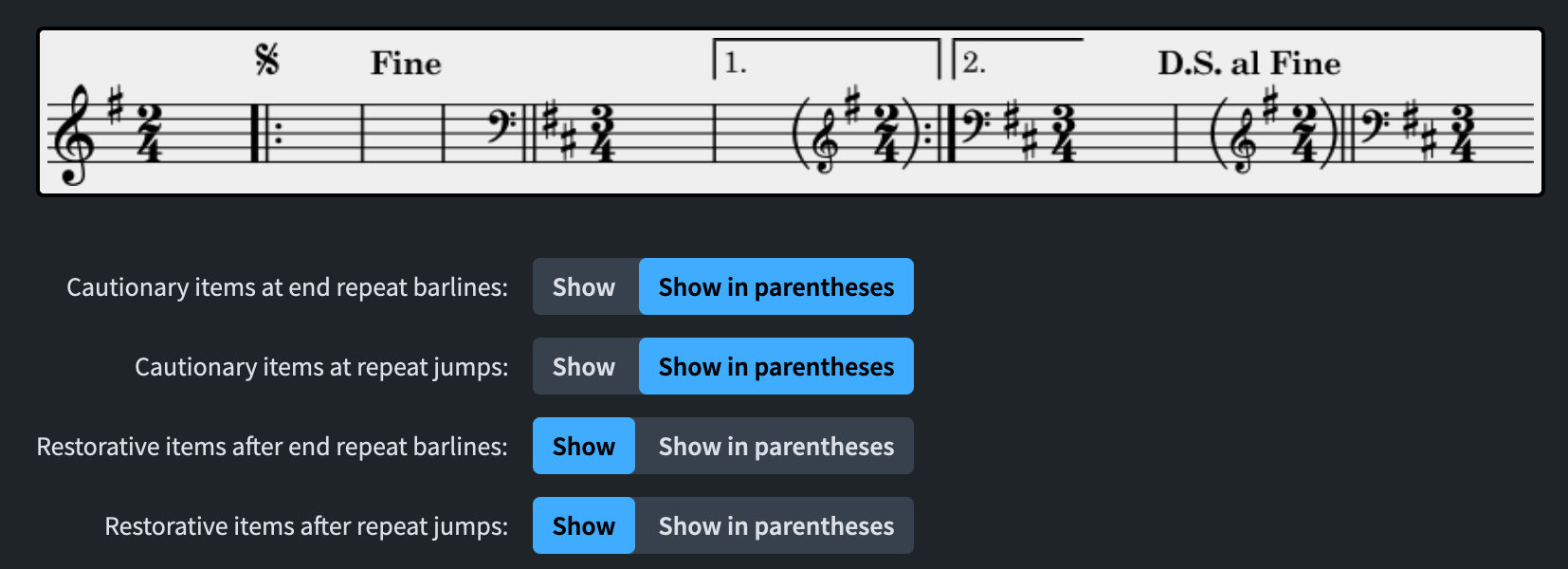
For example, if jumping back at a first ending to an earlier point in the flow, if there has been an intervening change of clef, Dorico can show the clef at the bar the repeat ending jumps back to, so that the performer has early warning of the change of clef; similarly, when jumping forward to the final ending in a repeat ending, if a cautionary clef is shown for the preceding ending, it may be necessary to show a restorative clef at the beginning of the final ending to remind the performer that the intervening clef change still takes effect.
These new cautionaries at repeats are enabled by default in new projects, but in order to maintain the appearance of existing projects, they won’t appear by default there: to enable them, you must set the new Clefs and key signatures in repeat structures option on the new Repeats page of Notation Options to Track. (Dorico warns you about this on the Repeats page of Layout Options.)
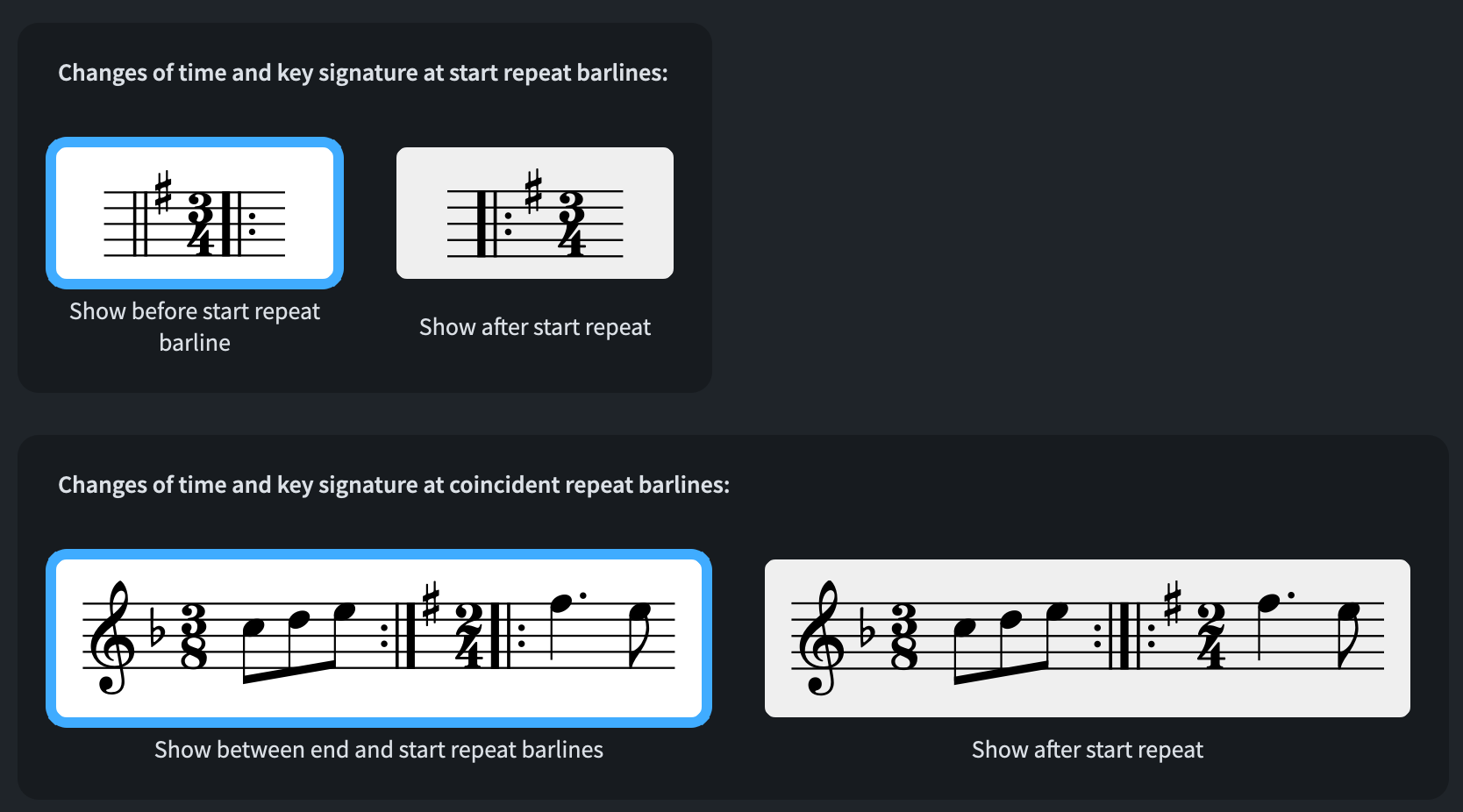
In addition, you can now choose whether changes of key and time signature that coincide with repeat barlines should be positioned to the left or right of a start repeat barline, or between the end and start repeat barlines of a combined repeat, or to the right of the start repeat barline. This has been a very long-standing request, and we are pleased to be able to introduce these options in Dorico 6.2.
There is still more work to be done to support notation across repeats more generally, in particular with items with duration that can cross repeat jumps (for example, slurs, ties, dynamics, lyrics, note-attached lines such as glissandos, and so on), and we plan to return to this area to increase Dorico’s capabilities in future versions.
Guitar tablature
There is considerable variation in the way guitar techniques such as bends, tapping, vibrato bar dips, harmonics, and so on are notated in tablature. There are perhaps two or three sets of conventions more widely used than others: from the US, the publications of Hal Leonard and Guitar World magazine represent two distinct styles; from Europe, Guitar Techniques and Guitarist magazine represent a third style. This latter style is also used in the popular Trinity/Rock School guitar syllabus, so it is becoming more widely used and understood by players.
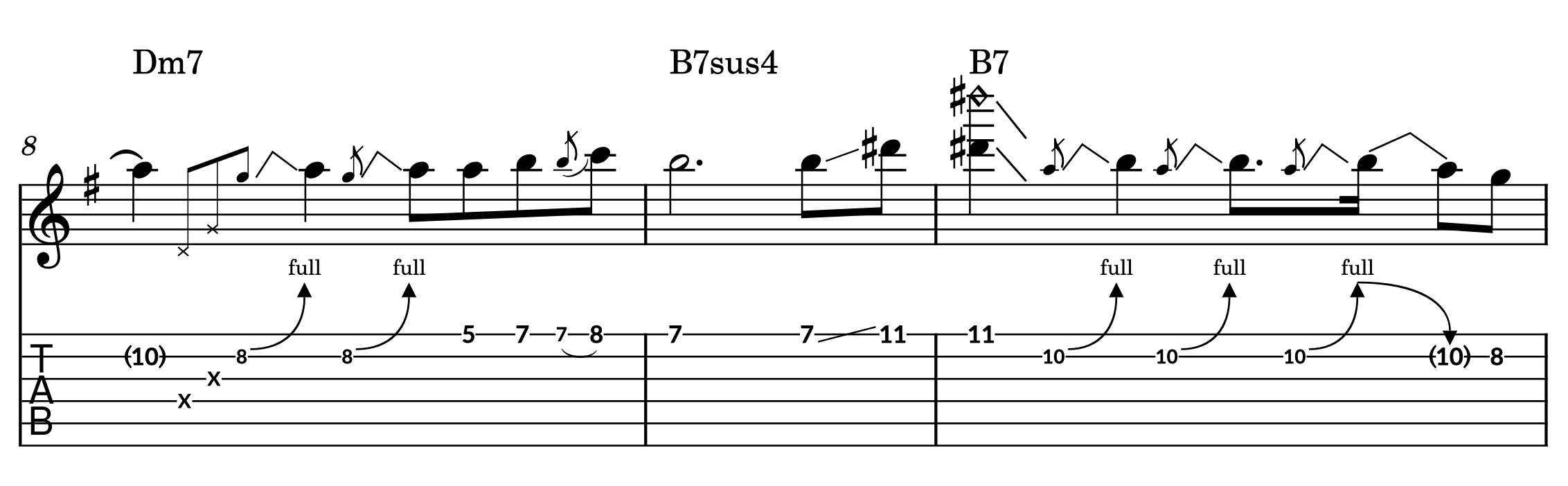
Guitar notation in the US Hal Leonard style
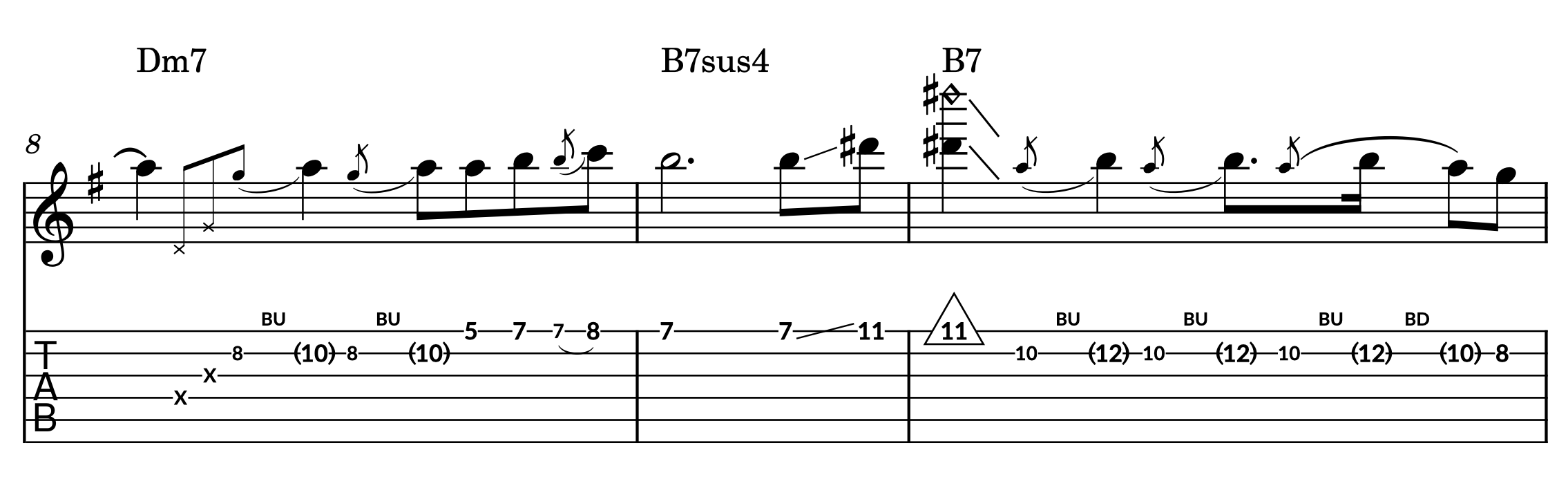
Guitar notation in the European Guitarist style
Dorico 6.2 introduces a range of features to support the European style of guitar notation, all of which are enabled in the Engraving Options dialog.
- Bends are drawn as slurs in staff notation and with BU/BD markings in tablature, with the bent-to notes shown in parentheses; this is enabled on the Bends page
- Right- and left-hand tapping is indicated with enclosures around noteheads and fret numbers; this is enabled on the Guitar Techniques page
- Vibrato bar scoops are drawn as a curved arrow with the text Scoop above them; this is also enabled on the Guitar Techniques page
- Harmonics are indicated with enclosures around fret numbers in tablature, and sequences of consecutive harmonics are indicated with NH or PH lines above the tablature, while artificial harmonics show the touched fret number above the top string; this is enabled on the Harmonics page
- Tied notes in tablature are indicated with square brackets in tablature; this is enabled on the Tablature page
Dorico 6.2 has the richest support for this European style of guitar notation of any application, and the team at Rock School will be using Dorico to publish their updated guitar exam syllabus that will be rolling out over the next couple of years.
Harmonics
Building on the new functionality for harmonics introduced in Dorico 6.1 – in which we made concrete the relationship between the Node and Partial properties for harmonics on stringed instruments, and showed the correct touched pitch for artificial harmonics based on the chosen node – we have continued to expand Dorico’s functionality for harmonics in Dorico 6.2.
New options for the notation of both natural and artificial harmonics on stringed instruments have been added, making it possible to show three pitches: the open pitch of the string on which the harmonic should be played; the touched or stopped pitch required to produce the harmonic; and the sounding pitch of the harmonic itself. Because the harmonic may be written on many ledger lines above the staff, it’s even possible to add an octave line and then set a new Artificial harmonic sounding pitches only property to write the harmonic pitch in a lower octave.
Further new options on the Harmonics page of Engraving Options allow you to choose which notehead set should be used for each different harmonic appearance. And as part of the work to support the European guitar tablature style described above, there are further improvements for harmonics in tab, including enclosures around fret numbers and indications of sequences of harmonics.
Finally, it’s now possible to create harmonics quickly using the Shift+P popover, instead of having to set multiple properties in the Properties panel. You can type simple instructions like nh or ah for natural and artificial harmonics, all the way up to things like harm nat p4 n1 style=diamond s1 (which will create a natural harmonic, partial 4, node 1, on the top string, using the diamond notehead appearance). Full details of the popover syntax can be found in the Version History.
Engraving improvements
In addition to the significant changes in the handling of repeats and guitar tablature, there are other improvements to the graphical appearance of music in Dorico, including:
- New engraving options for the default thickness of beam lines and the gaps between beams
- It’s now possible to erase the background behind fingerings outside the staff, which might be useful if you want to manually position fingerings near slurs
- Greater control over the appearance of harp pedal changes using note names, including choice of accidental design, and scale and baseline shift options for accidentals
- New properties for hiding rhythm dots and adjusting the horizontal position split stems have been added for notes and chords
- A new option for the horizontal placement of pedal line lifts has been added
- Separate engraving options for each sequence of rehearsal marks (letters, numbers, bar numbers) have been added, allowing you to specify a different enclosure type for each.
And there are other improvements to discover: check the Version History for the comprehensive list.
Workflow improvements
There are a couple of useful workflow improvements in this update, too, including a new option, found in the Editing section of the Note Input and Editing page of Preferences, to change the way selecting items with the mouse at low zoom levels works. By default, Dorico makes the click targets for all items a little larger than their actual size at low zoom levels, to make them easier to select. This includes stems – which select all noteheads on that stem – and beams – which select all noteheads on all stems within the beam. This can make it difficult to select individual notes on a stem, for example, because you will often end up clicking in the area occupied by the stem’s padding.
Depending on the kind of work you do, this might be inconvenient: so now you can set the new Prioritize noteheads option, in which stems and beams no longer have their click targets padded, meaning that it is much easier to select individual noteheads in chords at low zoom levels.
We’ve further improved the new Auto playback template first introduced in Dorico 6.1. If you have the full Etude grand piano license, Dorico will automatically use that instead of the cut-down Etude Elements included with Dorico Elements and Dorico Pro. Similarly, if you have the free Navia Harp instrument, Dorico will automatically use that in preference to the harp from Iconica Sketch. Furthermore, Dorico will prompt you to switch to the Auto playback template for existing projects that use older factory playback templates when you open them for the first time in Dorico 6.2: of course, you are free to refuse, which will ensure that your projects continue to play back exactly as they did in earlier versions.
Dorico 6.2 also includes more than 70 bug fixes to problems reported in Dorico 6.1 and earlier versions: again, refer to the Version History PDF for the complete list.
What’s next
As always, we are hard at work on future Dorico updates. You can expect at least one more small update to Dorico 6, but our attention is now largely focused on the next major version of Dorico. As always, we welcome your feedback, and we love to hear about how you’re using Dorico, and how we can make it even better for you. Please share your thoughts via our forum.
In the meantime, we hope you enjoy using all of the new capabilities provided by Dorico 6.2 and look forward to seeing and hearing all of the incredible music you will make with it.
Does not affect me.